Ancient legend
In Charles Whistler’s book, Havelok the Dane, Grim was a merchant who had been trading with England. He frequently visited Saltfleet, which was a prosperous port, and Tetney. He lived on the west coast of Denmark where the king was Gunnar Kirkeban. Grim’s Jarl was a man called Sigurd, who was a counsellor to Gunnar.
Well loved by Jarl Sigurd was Grim, who had been his faithful follower, and was the best seaman in all the town. He was also the most skilful fisher on our coasts, being by birth a well-to-do-freemen enough, and having boats of his own.
Havelok The Dane, Charles Whistler
Grim had a wife called Leva, three sons (Raven, Withelm and Radbard) and two daughters called Gunnhild and Solva. One day, Hodulf arrives in Denmark with an army and slays King Gunnar in his hall and takes Havelok hostage.
Grim is given a heavy sack by Hodulf and told to tie an anchor to it and sink it at night, and then to come and claim his reward. He doesn’t, but instead opens the sack and sees a young boy inside, who turns out to be Havelok.
He is as I thought – he is Havelok, the son of Gunnar, our king. Hodulf gave him to me that I might drown him.
Grim, Havelok the Dane
Knowing at that point, all their lives are in danger, Grim gathers his family and along with a retinue of men, they flee and head to England and Lindsey where the merchant Grim has friends.
Grimsby
On heading northward up the Humber the book gives us a wonderful description of the first sighting of the settlement.
The tide fell, across the spits of sand that ran between the mudbanks, and we climbed the low sandhill range that hid the land from us…the level country between us and the hills was fat, green meadow and marsh, on which were many cattle and sheep feeding.
Here and there were groves of great trees…and on other patches of rising ground were the huts of herdsman, and across the wide meadows glittered and flashed streams and meres.
The beginning of Grimsby, Havelok the Dane
The east coast was a swathe of marshlands that stretched from East Yorkshire down to Skegness. Islands of sandhills reclaimed from the marshland appeared out of the water. The islands are what the Saxons call ig/eg pronounced ee – and found in such forms as ey, ea, ay, e. The Anglo-Saxons had settled in Britain in the fifth to seventh centuries.
The place he had arrived at had no name it seems. Grim settles and builds a home for his family here after being invited to by Witlaf the thane from Stallingborough.
“Now, we must call the place by a name, for it has none. Grim’s Stead maybe?”
“Call this place a town at once…Grimsby has a good sound to a homeless man.”
Havelok the Dane
He settled and became a prosperous fisherman, selling his wares at the market in Stallingborough.
Bluestones
The bluestones were set by Grim on four boundaries of his land. It was unlucky to move a boundary stone.
From historic books on the town we know one boundary stone was down Wellowgate. These blue stones were glacial erratics deposited after the melting of the glaciers.
Death of Grim
After a famine caused by a lack of rain, Grim dies in the book. He’d been unwell but on his death a thunderstorm arrives and the rain arrives.
His wife Leva died the night after. They were buried together under a mound on the highest sandhill and on top of it the family lit a fire.
We set his weapons with him, and laid him in the boat that was his best – and a Saxon gave that – and in it his oars and mast and sail, and so covered him therein. And so he waits for the end of all things that are now, and the beginning of those better ones that shall be.
Havelok the Dane
Burial
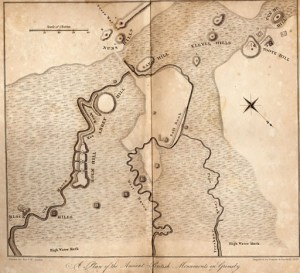
So where was Grim buried? A question I often get asked on my walk around Grimsby. Where was the highest sandhill?
This map shows the sandhills – Abbey Hill was where Wellow Abbey would be built, Sand Hill is in the area of present day Cambridge Road. St Mary’s Church which stood in the centre of town was built by the Saxons and was in a prominent position, being a beacon for sailors coming up the Haven.
Holm Hill, where St Mary’s Catholic Church stands, was said to be prominent out of them all – so is this where Grim and his wife were laid to rest? To have accessed it they would have had to have gone through the marshes.
The people who lived in the settlement when Grim arrived were Welshmen – Celts or Ancient Britons who had converted to Christianity. The Saxons were still pagans and they went to the temple of Thors-way (Thoresway). Though in reality, St Mary’s was built by the Saxons.
In the book, after Grim’s death it continues with Havelok’s story and how he went to Lincoln and met Goldberga. He calls himself Havelok Grimsson (son of Grim) of Grimsby.
Grim Falfest
In August 2022 we welcomed the news that there was to be a celebration of our Viking heritage and Scandinavian connections.
It’s a great opportunity to learn more about our heritage, culture and language. Grim is returning. This new event ran from Friday 23 September to Sunday 26 September in Grimsby. It ran in 2023 but after lottery heritage funding ran out, has not been sustainable to carry on.
In order for it to continue it needs support and sponsorship from the business community and some elements of the event need to be paid tickets to ensure its survival, and along with the selling of merchandise it could help sustain the main event.
 Guided Tours around North East Lincolnshire