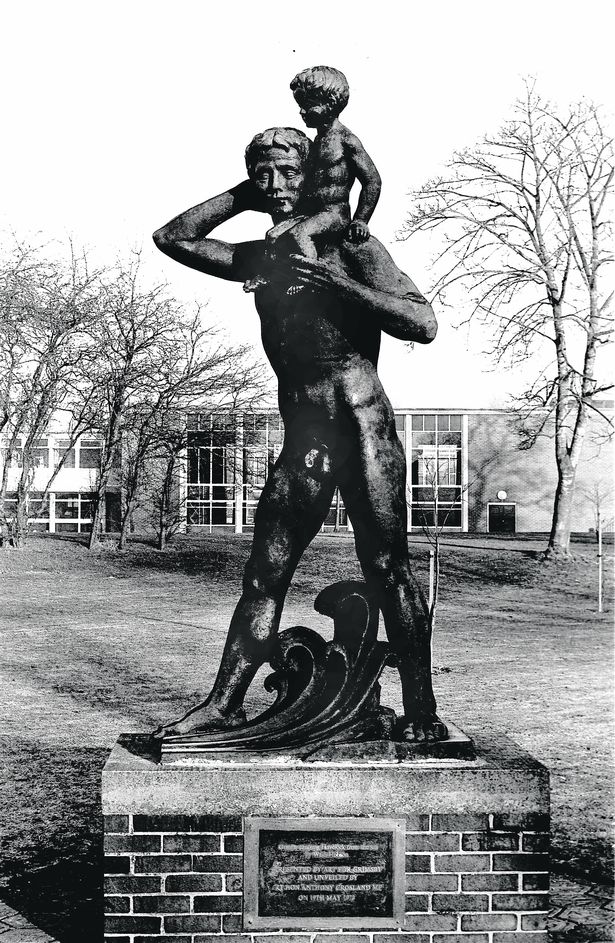
Grim – the founding father of Grimsby and saviour of Havelok.
What truth is there in the legendary tale of how a Danish fisherman saved the Prince of Denmark and founded an English settlement?
Many will remember the statue (above) sited at Nun’s Corner outside the Grimsby Institute. It was commissioned in 1973. Built of fibre glass and showing Grim as an athletic man carrying the young Prince on his shoulders out of the water, it was subject to vandalism. Certain parts of Grim’s anatomy would fall off.
Another image of Grim is on the town’s seal, which dates to the 14th century. This shows Grim as a brave warrior carrying a shield and sword. At his feet are Prince Havelok and Princess Goldborough. The original seal can be found in the archives, while a blown up copy of it is on the side of Grimsby Library by the main entrance and obscured by the ramp.
Grimsby, on the east coast, has its roots in Scandinavian mythology. Ask any Grimbarian and they can recall the tale of the Danish fisherman Grim, who rescued Prince Havelok from the stormy sea and brought him to England, whereon the Prince fell in love and married Goldborough. While Grim founded a town and lived in an upturned boat.
Whether the tale is fact or fiction, the town seems to have its roots in the Viking ages. The fisherman’s name, Grim linked with the Scandinavian suffix -by, which means the village or farmstead of Grim. Grim(r) being a Scandinavian first name, which is well documented.
What truth is there in the legend? What year did the legendary Grim arrive? What can we learn from the word ‘grim’?
Meaning of the word grim
Let’s begin with understanding the meaning of the word grim. For us in the modern age, it’s an adjective meaning:
- very serious or gloomy:
- (especially of a place) unattractive or forbidding:
Grimr is/was a popular Scandinavian first name. It was used by the followers of the Norse God Odin. Odin being the father God married to the goddess Frigg – connected with fertility.
There are many places in England bearing the name Grim. It could be that these settlements were named after the followers of Odin – Grim was one of the many names the shapeshifter God was called, – or maybe named after the Chieftain who bore the name Grim.
In old Welsh Grym means strength. Could this settlement have been called by this Celtic name and adopted by the Danes?
In Old Norse Grim meant an unattractive, forbidding place in the marshes. Quite appropriate when you cnsider The Haven running off the Humber cuts through a msrahland landscape. It’s how the East and West Marsh came to be named.
This east coast landscape was low lying with springs, creeks running across it. An area of wetland inhospitable that flooded with the tides. You can imagine the Danes sailing down The Haven, standing looking out at the wet landscape populated with islands and saying “It’s a bit grim”. In most cases places are named after the topography or geography, and so calling the settlement Grimsby – the forbidding settlement in the marshes makes total sense.
Who were the Danes?
The period referred to as the Viking Age dates from around AD 800 to 1050. The homelands of the Vikings were in Scandinavia, but the countries of Scandinavia as we know them today did not exist until the end of the Viking Age.
Throughout Viking-age Scandinavia the main occupation was the production of food. Farming, fishing, trapping and collecting were the main activities in the annual cycle.
There is no evidence to suggest that they had to leave to find new land on which to settle their growing population, as studies have shown that there was sufficient land available in Scandinavia.
It is more likely that local chieftains or aristocrats who felt themselves under threat by powerful neighbours, or by rulers who wanted to strengthen their grip by uniting their territory into one kingdom, opted to look for new lands across the sea.
The Vikings hold us with a fascination – the Norsemen who conquered France became the Normans who conquered England. The Vikings who conquered England were conquered by the Normans. These people settled, take local wives and give their children Viking names.
Vikings are made up of those from Denmark, Sweden and Norway – in later years the Icelandics. Viking means raider. It is not a race.
It began with ‘hit and run’ raids in to England, but then in 865 Viking armies combined and landed in East Anglia to conquer the Anglo Saxon lands.
The –ing place-names, which are characteristic of the Saxon state are not conspicuous in Lincolnshire, but the –bys and the –thorpes abound.
Grimsby – by the settlement or farm of Grimr; or as we learn it becomes known as mekill Grimesby derived from Old Norse (mikill means ‘great’) Great Grimsby.
Those Danes that settled here came with Halfdan Ragnarson’s Great Heathen Army from (865-873) mid-9th century. The first raid in Lincolnshire is recorded in 841AD. In 871AD the Vikings campaign was reinforced when the Great Summer Army arrived.
The town seal
The fact Grim or Grimr is seen as the founder of the town can be seen on the borough seal and in these lines from The Lay of Havelok the Dane (lines 743-48):
And for þat Grim þat place auhte,
Þe stede of Grim þe name lauhte;
So þat Grimesbi it calle
He þat þer-of speken alle;
Bituene pis and Domesday
Grim stories were known about by the early settlers from the 12th Century – they knew their ancestors had come from across the sea. Some believed he was buried in the town, but where did this arise?
The seal shows there is some truth, there’s always a grain of truth in a legend – maybe he was a great man from Denmark who bore the name Grim and the stories were woven around him.
The borough seal dates to the 13th Century. It shows a resplendent Grim bearing a sword and shield with an ornate boss and rim taking centre stage. He is seen more like a warrior than a fisherman or merchant. Some have likened the pose to that of Orion. He has short hair, clean shaven, but has a moustache. By his feet is a conical object, probably a helmet. Above him is a hand, the hand of providence by which Havelok was preserved. Near the hand is a star which marks the start and end of the inscription.
Around the edge are the latin words “Sigillum Commune Burgensium Grimebye” – The Common Seal of the Burgesses of Grimsby.
Academics say the seal is as old as the time of Edward I (1239 -1307), which makes it contemporaneous with the manuscripts of Lay of Havelok. Note the seal is written in a character which fell out of use after 1300.
Grimsby became a parliamentary seat in 1295 returning two MPs until 1832.
The seal appears to have gained life following the Lay of Havelok, so let’s turn to look at this manuscript.
The Lay of Havelok
This poem is known in two earlier Anglo-Norman versions, one by Geffrei Gaimar and another known as the Lai d’havelok.
The story of Havelok is first told in lines 37–818 of Geoffrey Gaimar’s Anglo-Norman Estoire des Engleis of about 1135–40, which was the basis for another Anglo-Norman poem, the Lai d’havelok, which in turn may have influenced Havelok the Dane by Charles Whistler, which became a best seller in the 1900s.
Havelok is the second oldest surviving romance written in English, after King Horn; it is believed to have been composed somewhere between 1285–1310. Academics analysing the manuscript believe it may well have been written in Lincolnshire about 1301 or just prior after examining the different dates in the text. If it dates to the 13th century, it equates with the date of the town’s seal, which is said be to based on the poem.
The poem is saturated with Norse words. It is worth a read, the English version was thought lost, until it was discovered in the 19th century.
In this version Havelock has a royal birthmark, a cross shape on his shoulder and his father is King Birkabein. The King dies and Godard holds the crown, but he murders Birkabein’s daughters and gives Havelok to Grim to murder. Grim spares his life and they flee to England.
Havelok the Dane
There is a novel ‘Havelok The Dane: The Legend of Grim‘ which tells the story of how Havelok was saved by Grim. Havelok, Prince of Denmark and heir to the throne – his father the king slain by Hodulf, a Norseman, who assumes the title.
Written by Charles Whistler in 1899 and first published in 1900, it became popular. It was reprinted in 2000 by the Grim and Havelok Association.
It is based on the Norman French poem, The History of the English by Geffrei Gaimar and The Lai d’Havelok (Lay of Havelok).
In Whistler’s book, Grim is asked to kill Havelok, but instead flees Demark with him and finds a new settlement in England. Havelok goes on to marry the English Princess Goldborough who helps him gain his Danish kingdom back. To read more on this visit the Whistler blog post.
Conclusion
In my opinion the Danes who landed here, in what was to be called Grymesby, named it after the marshland landscape – a forbidding place in the marshes.
It became known as mekill Grymesby – Great Grimsby.
In the late 1200s an unknown author wrote a poem Havelok the Dane, written in the Lincolnshire dialect and smattered with Old Norse words. This may have been a descendant from the first settlers. In it Grim is depicted as a hero and the town suddenly has a back story, rather than reality being a settlement in the wet, forlorn marsh landscape.
This PR spin then saw the creation of the town seal to celebrate this legendary man. Then in 1900 Whistler took these stories and poems and created his own, at a time when the town was on the cusp of greatness and riches from fishing. Putting it in the spotlight once again.
Cut to 2022 and born out of my idea to celebrate the town’s founder we have Grim Falfest and the townsfolk are once again talking about the man who started it all.
I’ll let you form your own opinion, but in every legend there’s a grain of truth.
 Guided Tours around North East Lincolnshire