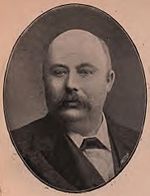
One of the great philanthropists in Grimsby was George Doughty. From humble beginnings to becoming a knight, the town was at the heart of everything he did.
Who was he?
In his life he worked as merchant, ship owner and was a partner in Hagerup, Doughty and Co. He was also a carpenter and had a workshop in Maude Street where he lived with his wife and children.
George was born on 13 March 1854. He was the son of William and xx. He grew up at 8 Robinson Street and was educated at the Wesleyan Day School in George Street. In May 1862 he moved from the infants to the upper school.
Career
He left school aged 13 and went to work for Mark Shepherd, who had a furniture shop with a workshop at the rear. This stood on the corner of Wellington Street and Freeman Street – now known as the Wellington Arms.
After a short time he became apprentice to Johnny Brown, a builder based in Victoria Street. It was during this time he joined a debating society in the Baptist schoolroom in Burgess Street.
After his apprenticeship, he joined up with George Woodhead and formed Woodhead & Doughty. They had premises near the footbridge in Central Market, which in 1912 was owned by Beels and Axe.
Running his own business he did the woodwork in Flottergate Methodist Chapel and built properties in Princes Avenue and Dudley Street, including Gordon House where he lived for a time.
In 1888 along with Thomas Baskcomb, he formed the North Eastern Steam Trawling Company.
On 4 April 1890 he met Frederick Hagerup, ex-Russian Consul and they formed Hagerup & Doughty.
In 1891 the International Steam Trawling Company was formed with George as chairman and Thomas Baskcomb as a director. By 1898 they had 38 trawlers, a twine factory in Ropery St, and a ship building yard on Bumble Creek.
In that same year George was also elected chairman of the Grimsby Times & Telegraph Co., a newspaper business which Hagerup & Doughty purchased. At the time the company produced three papers: the nightly Grimsby Telegraph; Grimsby Times on a Friday and Grimsby Saturday Telegraph. The latter was the official paper of the Unionists and his son Wilfred would become the editor.
By 1905 Hagerup & Doughty, The Ice Factory and the Monarch Steam Trawling Co amalgamated to form the Consolidated Steam Fishing Company. It had 94 trawlers.
Methodism
George considered joining the primitive ministry but his father could not afford the fees.
Methodism was central to his life and he did later become a lay Methodist preacher and had strong views on drinking.
In May 1883 he was one of the travelling preachers delegates who attended a conference in London. He attended the temperance meetings as a reader.
Politics
He became interested in politics and became a town aldermen. He was also Mayor of Grimsby in 1892 and xx .
His love for politics began in 1879 when he was elected as a member of the Liberal Registration Association in Barton.
On 1 November 1884 he was elected on to Grimsby Town Council. By 1885 he was chairman of a Demonstration Committee set up to oppose the closure of the town’s Peoples Park by the council. He was called as a witness when one of the committee was charged with obstruction.
At the time the council charged an entry fee into the park and the committee was set up to protest that as the council owned the park and they were ratepayers, they had the freedom to enter the park without payment.
In 1891 he was elected as alderman for the County Borough of Grimsby.
In 1895 stood in the general election was elected as member of parliament for Grimsby for the Liberal Party.
In 1898 he resigned his seat after disagreeing with Gladstone s Home Rule and joined the Liberal Unionists, and was re-elected in the by-election with an increased majority. He was defeated in the January 1910 election, but won his seat back later in the year.
Two years later he joined the Conservative Party when the Liberal Unionists merged. He remained the town’s MP until his death, when he was succeeded by the jam manufacturer, Thomas Tickler.
Knighthood
In June 1904 he was knighted for his services to xx in the King’s Birthday Honours. On the same list was one Doctor Edward Elgar.
Marriage
His first wife, Rebecca Vere, was the niece of John Vere, who owned the firm Smith, Stephenson and Vere engineers, and the daughter of Thomas Warrs Vere, an engineer.
Rebecca worked as a grocery assistant in a store run by Henry Smethurst Senior. This shop was on Victoria Street near to Lock Hill.
They married on 10 April 1879 at the Victoria St Primitive Methodist Chapel. Rev Robert Harrison presided and the marriage was witnessed by Henry Smethurst Senior and Annie Doughty, George’s sister.
The couple lived in Maude Street where he used the rear workshops for his business. His two children, Wilfred Vere and Annie Vere were born here. Annie would go on to marry Roland Charlton, his father was a ship builder.
In 1892 the family moved to Wood Furze – a house he had build for himself. It stands on the corner of Abbey Road and Wellowgate. You can learn more about this house on my Abbey Road tour.
His wife Rebecca died on their daughter’s 21st birthday on 14 January 1904.
He met his second wife, Eugenia Stone OBE while on a cruise to India in 1907. She was an Australian journalist. They were married on 15 August 1907 at St James Church, London. He was 53 and she was 28.
They received wedding gifts from the parliamentary party and the corporation which included a coat of arms.
In Grimsby in honour of the marriage, bunting was displayed in front of all the buildings, public and commercial. Numerous flags were also flown.
Death
Sir George died on 27 April 1914 at his home in Waltham – the Hall. He was given a state funeral in the town.
He left £47,000 in his will and is buried with Rebecca in Waltham parish church – which was opposite the Old Hall.
His wife Eugenia continued to live in the Hall until it was put for sale in 1917. She spent her life in Grimsby until that point working on fundraising for the Unionists, women’s suffrage and entertaining the children of St Anthony’s Orphanage in the annual picnics at the home. She then moved to Surrey.
Waltham Hall
At the time of the sale, the brochure depicted some of the wonderful items for sale.
Including a full sized billiard table, carpets by Axminster, Dresden figurines, a Wolseley car, Chippendale furniture, and numerous items of silver.
Footnote – Scandal
In 1923 Lady Eugenia Doughty was cited in divorce proceedings of Arthur Tickler and his wife. His wife brought the petition on the grounds of Arthur’s cruelty and his misconduct with Lady Doughty. She had found a series of letters between the two showing they had had an affair. Mrs Tickler had confronted Lady Doughty and begged her to leave her husband alone.
Mr Tickler had found out and burst into his wife’s bedroom wielding a revolver and threatened to shoot her.
Divorce was granted on the grounds of the love letters between the two. The lovers never married.
Lady Doughty died at her Esher home in 1934. She was described as a charming woman, who made many friends.
A staunch Conservative, she founded the local women’s organisation – the Grimsby Unionist Women’s League in 1910. During the First World War she undertook many fundraising activities for the prisoners of war in Ruhleben Camp – many of them fishermen.
Her funeral took place at St Mary’s RC Church in Grimsby and she in buried at Scartho Road Cemetery in a family plot with her niece, Cherry Stone
 Guided Tours around North East Lincolnshire